Mission Jacked.com
Anabolic Resistance After 50:
Why More Effort Stops Working
Written by Psymon H. — Mission Jacked, Muscle and Resilience After 50

Explore the Unbreakable After 50 Book
You train harder.
You add another exercise.
You squeeze in more sets because the workout did not feel substantial enough.
You leave the gym tired, sore and satisfied that you gave your body every possible reason to grow.
But it does not.
The muscle that once seemed to arrive as a natural consequence of hard training now has to be fought for. Progress slows. The mirror stops changing. The same weights begin appearing in your training log month after month.
So you apply the lesson that worked when you were younger.
You do more.
More weight. More volume. More days. More intensity.
And still, very little happens.
This is where many men conclude that age has finally caught them.
It has not.
But the way your body responds to training has changed—and repeating a larger version of your old approach may only create more fatigue.
Your muscles have not necessarily stopped growing because you are too old.
They may have stopped responding to the way you keep asking.
The Short Answer
Anabolic resistance after 50 describes a reduced muscle-building response to resistance training and protein. It does not mean muscle growth has become impossible. It means the signal from training, nutrition and recovery may need to be clearer and better coordinated. Simply adding more exercise can increase fatigue without producing a stronger reason for the muscle to adapt.
More effort is not always a better signal.
Sometimes it is just more noise.
What Is Anabolic Resistance After 50?
Muscle is constantly responding to what you ask it to do.
Resistance training creates a demand. Protein provides the raw material. Recovery gives the body time and capacity to adapt.
When that process works, muscle protein synthesis rises sufficiently to repair and build tissue.
With age, inactivity, illness and other forms of physiological stress, the muscle-building response to training or protein can become less pronounced. Researchers commonly describe this as anabolic resistance.
It does not mean that protein has stopped working.
It does not mean resistance training has become pointless.
And it certainly does not mean that every man crosses his fiftieth birthday and suddenly becomes resistant to muscle growth.
A review of the evidence surrounding age-related anabolic resistance argues that the condition is not necessarily an unavoidable consequence of ageing itself. Physical inactivity and poor health may account for part of the reduced response often attributed to age.
That distinction matters.
If anabolic resistance were simply an age switch, there would be little you could do.
But if your response is also influenced by activity, health, training quality, nutrition and recovery, then there is still plenty within your control.
The body has not closed the door.
It has become less willing to open it for a weak or confused signal.
Click To Explore the Unbreakable After 50 Book
Why Muscles Can Stop
Growing After 50
Most men think muscle growth is a direct reward for effort.
Train hard enough and the body must respond.
That idea is emotionally satisfying. It is also incomplete.
The body does not measure how badly you wanted the workout.
It does not know how disciplined you were for arriving at the gym in the rain.
It does not award extra muscle because you trained until your T-shirt was soaked.
It responds to the physical demand placed on the tissue—and whether it possesses the resources and recovery capacity to adapt to that demand.
This is why two workouts can feel equally difficult while producing very different results.
One directs meaningful tension through the intended muscle and progresses in a way the body can recognise.
The other spreads effort across momentum, joints, supporting muscles, unnecessary exercises and accumulating fatigue.
Both workouts are hard.
Only one delivers a clean message.
When men experience muscle growth resistance after 50, they often respond by making the second type of workout even larger.
That does not solve the communication problem.
It amplifies it.
Training Hard but Not Gaining Muscle
Is Not Always an Effort Problem
Let us remove one possibility immediately.
Some men are not progressing because they are not training hard enough.
They stop a set as soon as it becomes uncomfortable. They repeat weights they mastered months ago. Their training feels busy, but nothing is being asked to change.
That happens.
But it is not the whole story.
There is another man who trains extremely hard and still fails to grow.
He turns every session into a test of character.
He adds techniques because ordinary sets no longer feel punishing enough. He chases soreness as evidence. He changes exercises before he has learned how to load the ones already in front of him.
The workout becomes a performance.
The muscle becomes one exhausted participant in a much larger event.
If you are training hard but not gaining muscle, the answer is not automatically to train harder.
First ask a better question:
What is your effort actually producing?
Is the intended muscle carrying the load?
Can you repeat and measure the performance?
Are you progressing the muscular demand—or simply increasing the amount of fatigue surrounding it?
Does your performance improve by the next session?
Or are you arriving with less strength, more joint irritation and another half-recovered workout still in your system?
Effort matters.
But effort has to be directed.
Age-Related Anabolic Resistance
Can Magnify Poor Training
A younger body can sometimes reward an untidy programme.
You can train too often, choose more exercises than necessary, sleep badly and still make progress. The size of the response allows a certain amount of waste.
That margin can narrow with age.
The same training errors now carry a larger cost.
A poor exercise choice irritates the shoulder for three days.
Unnecessary volume reduces performance in the next workout.
A session that finishes too late interferes with sleep.
A calorie deficit that once felt manageable now collides with training, work stress and poor recovery.
No single mistake appears catastrophic. Together, they weaken the muscle-building response.
This is why anabolic resistance after 50 should not be viewed as one broken mechanism with one magical fix.
It is often the result of several parts of the system failing to support one another.
The training signal is diluted.
Protein intake is inconsistent.
Energy intake is too low.
Sleep quality is poor.
Life stress remains high.
The next workout arrives before the previous one has produced its full return.
Then the man concludes that his muscles no longer respond to exercise.
They may be responding perfectly accurately to the entire situation.
More Training Volume
Can Create More Noise
Training volume is a tool.
It is not a moral standard.
Enough volume gives the muscle sufficient work to stimulate adaptation. Too little may fail to create a meaningful demand.
But once the useful work has been performed, additional sets are not automatically more productive.
Every set has a cost.
It consumes local muscular capacity, energy, time and recovery. It also places demand on joints, connective tissue and the rest of the system.
The first hard sets may create the clearest growth signal.
The later sets may add less stimulation while producing more fatigue.
That does not mean everyone over 50 should perform the same low number of sets. It means volume must earn its place.
Ask what each set contributes.
Does it expose the muscle to a demand that has not already been delivered?
Can you perform it with the same control and intent?
Does it improve your progress over time?
Or is it there because finishing the workout after fewer exercises would feel psychologically unsatisfying?
Many men do not have a volume problem.
They have a permission problem.
They do not feel permitted to leave the gym until they are exhausted.
But exhaustion and adaptation are not the same result.
Reduced Muscle Protein Synthesis
Is Only Part of the Story
Muscle protein synthesis is the process through which the body builds new muscle proteins.
Resistance training can raise this response. Protein feeding can also stimulate it. Over time, repeated periods in which muscle building exceeds muscle breakdown can contribute to growth.
Research indicates that older muscle may sometimes show a reduced response to these anabolic signals. But the practical lesson is not that men over 50 need to become amateur biochemists.
It is that the parts of the muscle-building process must stop working against one another.
A review examining ways to optimise the anabolic response to resistance exercise in older adults discusses the importance of resistance training alongside appropriate protein intake.
Training creates the request.
Nutrition supplies the materials.
Recovery allows the construction.
If one of those elements is missing, increasing another does not necessarily compensate for it.
You cannot endlessly increase training to make up for inadequate food.
You cannot consume enough protein to rescue a programme that never creates a progressive muscular demand.
And you cannot recover from a workload that is repeatedly larger than your available capacity.
Muscle Protein Synthesis After 50
Still Responds to Training
Anabolic resistance is often explained so badly that it sounds like an older muscle can barely hear the message to grow.
That is misleading.
Men can continue gaining muscle and strength well beyond 50. The response may be different from that of a younger beginner, but different is not the same as absent.
A recent scientific review of anabolic resistance, ageing and skeletal muscle describes the condition as a reduced response to anabolic stimuli, including exercise and nutrition.
Reduced does not mean erased.
The useful question is not:
“Can a man my age still build muscle?”
He can.
The better question is:
“What produces a sufficiently clear response in the body I have now?”
That shift changes everything.
Instead of trying to recreate how you trained at 25, you start building a system around how you respond today.
You judge exercises by where you feel the load.
You judge volume by what you recover from.
You judge frequency by whether performance is ready to improve.
You judge nutrition by whether it supports both health and adaptation.
You stop chasing proof that you can still tolerate punishment.
You start collecting evidence that your body is still adapting.
Poor Muscle Response to Exercise
May Begin Outside the Gym
The workout receives most of the attention because it is the visible part of the process.
You lift the weight. You complete the set. You feel the muscle working.
But adaptation happens after the set ends.
That means your poor muscle response to exercise may be influenced by what occurs during the other hours of your week.
Are you sleeping deeply enough to recover?
Are you eating enough total food to support growth?
Is protein spread across the day—or compressed into one large evening meal?
Are you carrying high levels of work and family stress?
Are you using alcohol as a sleep aid?
Are you dieting aggressively while expecting rapid muscular progress?
Are painful joints changing how you move and where the load travels?
The body does not isolate training from the rest of your life.
A demanding workout enters the same system already handling poor sleep, financial pressure, inflammation, pain and a calorie deficit.
Your programme may look reasonable on paper.
Your total load may not be.
Protein Response in Older Adults
Requires Consistency
Protein matters because muscle cannot be built without amino acids.
But the answer is not simply to consume the largest possible amount.
Your total intake matters. The quality of the protein matters. The amount eaten at a meal matters. How consistently you eat it matters.
Older adults may benefit from paying closer attention to whether each main meal contains a meaningful serving of high-quality protein, rather than allowing most of the day to pass on very little.
That does not require eating every two hours.
It does not require carrying six plastic containers wherever you go.
It means protein should become a deliberate part of the structure rather than something you remember at dinner.
Your exact needs will depend on body size, health, activity and goals. Men with kidney disease or other relevant medical conditions should discuss major dietary changes with a qualified healthcare professional.
Protein is not a magic signal.
It is the material required to answer the signal created by training.
Eating More Protein Cannot
Rescue a Confused Programme
The supplement industry loves a problem that can be solved with another tub.
Anabolic resistance after 50 is particularly convenient because it makes a man feel as though his muscles need something unusual.
Often, they do not.
They need enough total protein.
Enough food.
Progressive resistance.
A recoverable workload.
And time.
A protein shake can help you reach an appropriate daily intake. It can be convenient after training or when a normal meal is not practical.
But it cannot decide whether the set placed meaningful tension through the target muscle.
It cannot remove unnecessary volume.
It cannot repair six hours of broken sleep.
It cannot make an inflamed joint move well.
It cannot compensate for changing your programme every fortnight.
Use supplements to fill a defined gap.
Do not use them to avoid diagnosing the structure.
Click To Explore the Unbreakable After 50 Book
Muscle Adaptation After 50
Needs Progressive Evidence
Progressive overload is often reduced to one instruction:
Add more weight.
But heavier is only one form of progression.
You can also improve control, increase the range you can use safely, direct more of the load into the intended muscle, perform another clean repetition or reduce the assistance coming from momentum.
The important word is progressive.
The body needs evidence that the existing capacity is no longer enough.
But that evidence must be measurable.
If your exercise form changes whenever the weight increases, you cannot be certain what progressed.
If one week’s repetition is controlled and the next is thrown through the easiest part of the movement, the number on the machine may have risen while the muscular demand did not.
Muscle adaptation after 50 benefits from reducing those variables.
Use exercises you can repeat.
Control the movement.
Know what ends the set.
Record the performance.
Then give the body enough time to show whether it adapted.
Progress becomes much easier to detect when the experiment stops changing.
Resistance Training and Ageing
Require Better Exercise Selection
There is no universally perfect exercise.
There is only an exercise that suits the objective, the individual and the body available to perform it.
An exercise may be excellent in theory but wrong for your structure.
If a movement repeatedly irritates a joint, forces you into a painful position or prevents the intended muscle from carrying the load, you do not receive extra credit for persisting with it.
The name of the exercise does not build muscle.
The muscular demand does.
This becomes increasingly important when combining resistance training and ageing.
You need movements that allow you to apply high effort without unnecessary instability or joint punishment.
That may mean adjusting the grip.
Changing the range.
Using a machine.
Replacing an exercise entirely.
The goal is not to make training easy.
The goal is to remove the things that fail before the target muscle has been properly challenged.
Soreness Is Not Proof
That Muscle Growth Occurred
Soreness can appear after a productive workout.
It can also appear after unfamiliar movement, excessive lowering work, a sudden increase in volume or a poorly judged exercise.
That makes soreness an unreliable measure of growth.
If soreness lasts for days, alters the way you move or prevents you from performing well in the next session, it may be evidence that the cost was too high.
The same applies to exhaustion.
Feeling destroyed proves that the workout successfully destroyed your available energy.
It does not prove that it created the best possible growth response.
Judge training by what it produces over time:
Stronger repeatable performance.
More controlled repetitions.
Improved muscular development.
Stable joints.
Reliable energy.
The ability to return and progress.
A workout should be more than an impressive event.
It should be one productive step in a repeatable process.
Building Muscle After 50
Requires a Complete Structure
Men often separate their muscle-building plan into isolated compartments.
Training lives in one box.
Nutrition lives in another.
Sleep becomes something they will fix later.
Stress is treated as unavoidable and therefore irrelevant.
Joint pain is managed between workouts but ignored when the programme is designed.
The body does not respect those divisions.
Everything meets inside the same organism.
Your training influences sleep.
Your sleep influences performance.
Your food influences energy and recovery.
Your stress influences how much training you can absorb.
Your exercise selection influences inflammation and joint comfort.
This is why building muscle after 50 cannot be reduced to a list of exercises or a target protein number.
It requires a structure in which the separate parts stop competing with one another.
Why More Effort Has Stopped
Producing More Muscle After 50
Now we can answer the hub-page question directly.
More effort may have stopped producing more muscle because effort is no longer the missing ingredient.
You may already possess more than enough willingness to work.
The missing ingredient may be precision.
Your sessions may contain more work than you can recover from.
Your hardest sets may be limited by joints, momentum or supporting muscles rather than the tissue you want to develop.
Your protein intake may be inconsistent.
Your sleep may be too poor to support the demand.
Your programme may change too often for progression to become visible.
You may be adding training stress faster than your body can convert it into adaptation.
The solution is not less commitment.
It is a better use of the commitment you already have.
What to Do When You Are
Training Hard but Not Growing
Do not redesign everything in one night.
First, collect evidence.
Audit Your Exercises
For each movement, ask:
Where do I feel the resistance?
What usually causes the set to end?
Does the intended muscle fail—or does something else give way first?
Does the exercise repeatedly irritate a joint?
If an exercise cannot deliver a clear muscular demand, its reputation does not matter.
Audit Your Working Sets
Record your exercises, resistance and clean repetitions.
Do not count repetitions created by shortened movement, bouncing or momentum as if they were equivalent to the controlled repetitions that came before them.
Make the record honest enough to reveal progress.
Audit Your Volume
Identify the work that produces the strongest muscular demand.
Then look at everything performed after it.
Does that additional work improve results—or simply increase soreness and recovery time?
You are not trying to perform the smallest workout possible.
You are trying to find the amount that produces the largest return you can recover from.
Audit Your Recovery
Before repeating a workout, ask whether performance is ready to improve.
Consider muscle soreness, joint irritation, sleep, energy and recent life stress.
A scheduled training day does not guarantee that adaptation has finished.
Audit Your Nutrition
For one week, record the main protein source in each meal.
You do not need to obsess over every gram to notice whether half the day regularly passes without meaningful protein.
Also look at total food intake.
Expecting muscle growth while maintaining a severe and prolonged calorie deficit creates competing objectives.
Hold the Programme Still
Give your core exercises enough time to become measurable.
Constant novelty can feel stimulating, but it prevents you from knowing whether the body is actually adapting.
Repeatability is not boredom.
It is how evidence is collected.
Anabolic Resistance
After 50 Is Not a Verdict
The phrase sounds permanent.
It sounds as though your muscles have become resistant to your intentions.
But anabolic resistance is not a judgement on your potential.
It describes a reduced response—not the disappearance of one.
Your body can still adapt.
It may simply require a clearer reason, adequate materials and more respect for the recovery process.
That means the path forward is not built on panic.
It is built on precision.
Choose movements that direct the work.
Train hard enough to create a real demand.
Remove volume that produces cost without return.
Eat to support the objective.
Recover long enough for the work to become useful.
Then measure what happens.
You do not need to train like a younger man.
You need to build muscle with the body you have now.
Click To Explore the Unbreakable After 50 Book
Common Questions About
Anabolic Resistance After 50
Is Anabolic Resistance Inevitable After 50?
No. Age can influence the muscle-building response, but anabolic resistance is not identical in every older adult. Physical activity, health, nutrition, training and recovery can all affect how muscle responds.
Can You Still Gain Muscle
With Anabolic Resistance?
Yes. A reduced anabolic response does not mean muscle growth is impossible. Progressive resistance training, sufficient high-quality protein, adequate energy and appropriate recovery can still support meaningful gains.
Should Men Over 50 Perform
More Sets to Build Muscle?
Not automatically. More sets can help when the existing workload is insufficient, but unnecessary volume may add fatigue without meaningfully improving the training signal. Volume should be based on progress and recovery—not age alone.
Does More Protein Overcome
Anabolic Resistance?
Protein supports muscle protein synthesis, but simply eating more cannot compensate for poor training, inadequate total energy or insufficient recovery. Protein intake should be appropriate, consistent and part of the complete system.
Why Am I Getting Stronger
but Not Looking More Muscular?
Early strength gains can come from improved skill and nervous-system efficiency as well as muscle growth. Exercise execution, total training volume, nutrition, recovery and the length of time you have followed the programme can all influence visible growth.
How Long Does It Take
to Build Muscle After 50?
There is no universal timetable. Training history, health, nutrition, sleep, programme quality and starting condition all affect the rate. Look for measurable improvements in controlled performance before relying on changes in the mirror.
Anabolic Resistance After 50
Is Only One Part of the Structure
Unbreakable After 50: The Structural Rebuild explains why muscle growth, nutrition, recovery, inflammation, energy and training cannot be rebuilt as separate problems.
Across 74 chapters, the book gives men over 50 a complete framework for creating a body that does more than look strong.
A body they can rely on.
Not another collection of isolated muscle-building tips.
One structure.
You can also read Chapter One free and discover why strength after 50 must be judged by reliability—not memory.
Choose How You Want to Experience the Book
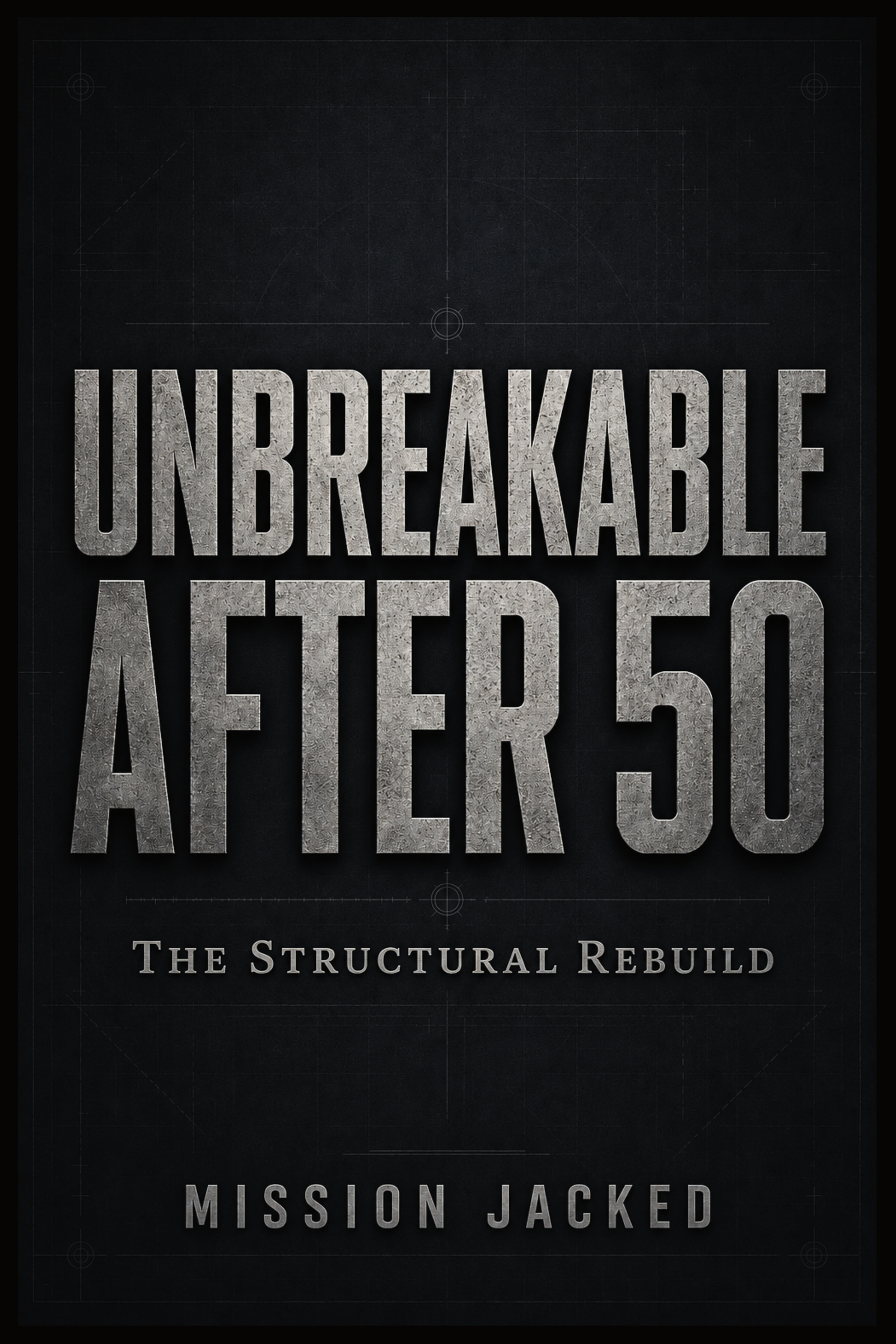


Click To Explore the Unbreakable After 50 Book
About Psymon H.
Psymon H. is the founder of Mission Jacked and a Muscle and Resilience After 50 coach. After more than four decades of training—and rebuilding his own body around serious injuries—his work focuses on helping men develop muscle, recovery capacity and structural strength that remain useful outside the gym.
His approach is not built around aesthetics, ego lifting or proving how much punishment a man can survive.
It is built around becoming harder to break.
Mission Jacked L.L.C
Address: 9407 NE Vancouver Mall Dr
STE 104 #1269
Vancouver, WA 98662 USA
Email: mission@missionjacked.com