Mission Jacked.com
Unbreakable After 50
Free Chapter
Read Chapter One of Unbreakable After 50 and discover why lasting strength for men over 50 begins with reliability—not effort alone.
Chapter 1
Strength Isn’t the Problem. Reliability Is
Most men over fifty believe they are strong.
They may not move as fast or recover as easily as they once did, but they remember what they built. They lifted. They worked. They endured. In their minds, strength is something earned—and something still possessed, even if it now lives more in memory than in daily expression.
In many cases, that belief is not entirely wrong.
But strength that exists only in controlled conditions—or only in the past—is not the kind of strength people rely on. It is potential, not readiness. Identity, not function.
For years, the cultural idea of “old man strength” reinforced this confusion. The image is familiar: thick hands, quiet power, forged by work and time. A man who can still lift something heavy when the moment demands it. The myth suggests that age itself hardens a man into something dependable.
It doesn’t.
What people actually depend on is not how strong you once were or how strong you believe yourself to be. They depend on how you function when something goes wrong—when pressure rises, when fatigue sets in, when decisions matter.
They do not ask about your training history. They do not care what you used to lift. They assess one thing, often without realizing it:
Can this man be relied on right now?
After fifty, that question becomes unavoidable.
Strength that cannot be expressed under stress, uncertainty, responsibility, or fatigue is not strength in any meaningful sense. It may look impressive in isolation, but it collapses when real load is applied. And as the years pass, the margin for collapse narrows.
Earlier in life, strength was about proving—proving toughness, capacity, and worth. It was measured in visible effort and external validation.
After fifty, the metric changes, whether you acknowledge it or not.
Strength becomes about being.
Being consistent.
Being prepared.
Being the man others move toward when things become unstable.
This is not philosophical. It is practical.
When something breaks—physically, emotionally, financially—no one cares how hard you trained. They care whether you are clear-headed, steady, and capable in that moment. Reliability is strength that survives pressure.
It appears as decision quality when tired, emotional control when stakes are high, and physical capability that has not been eroded by neglect or false confidence.
Most men do not lose strength because of age. They lose it because they stop maintaining readiness. They mistake movement for preparation, familiarity for effectiveness, attendance for discipline.
They feel strong—until strength is required.
True strength begins between the ears, but not in a motivational sense. It begins with control: the ability to regulate impulse, maintain focus, and act deliberately when comfort would be easier. An unreliable mind eventually produces an unreliable body.
Strength is not expressed through occasional heroic effort. It is built through consistent, non-negotiable behaviors carried out whether anyone is watching. The men who remain dependable later in life are not the most aggressive or intense. They are the most regulated. They understand that managing stress, load, and recovery is not weakness. It is strategy.
Leadership at this stage no longer looks like command.
It looks like gravity.
When something goes wrong, do people move toward you—or do they quietly handle it themselves?
That answer reveals more than any mirror ever could.
If you are steady, prepared, and capable, others feel it without explanation. If you are not, no amount of past strength compensates for it.
This book exists because too many men confuse strength with survival.
Unbreakable After 50 does not mean invincible. It means useful. Dependable. Capable under pressure. Everything that follows—training, nutrition, recovery, hormones, supplementation, and advanced tools—serves a single purpose:
To make you harder to break when it matters.
From this point forward, the question is no longer whether you are strong.
The question is whether you can be relied on when the load increases.
That is the standard.
THIS IS ONLY THE FIRST STANDARD
If this chapter forced you to rethink what strength means after 50, the remaining 73 chapters will show you how to rebuild it.
Training. Recovery. Sleep. Nutrition. Stress. Resilience.
Not as separate problems—but as one structure.
Choose how you want to continue.
CHOOSE HOW YOU WANT TO EXPERIENCE THE BOOK
THE COMPLETE DIGITAL BUNDLE
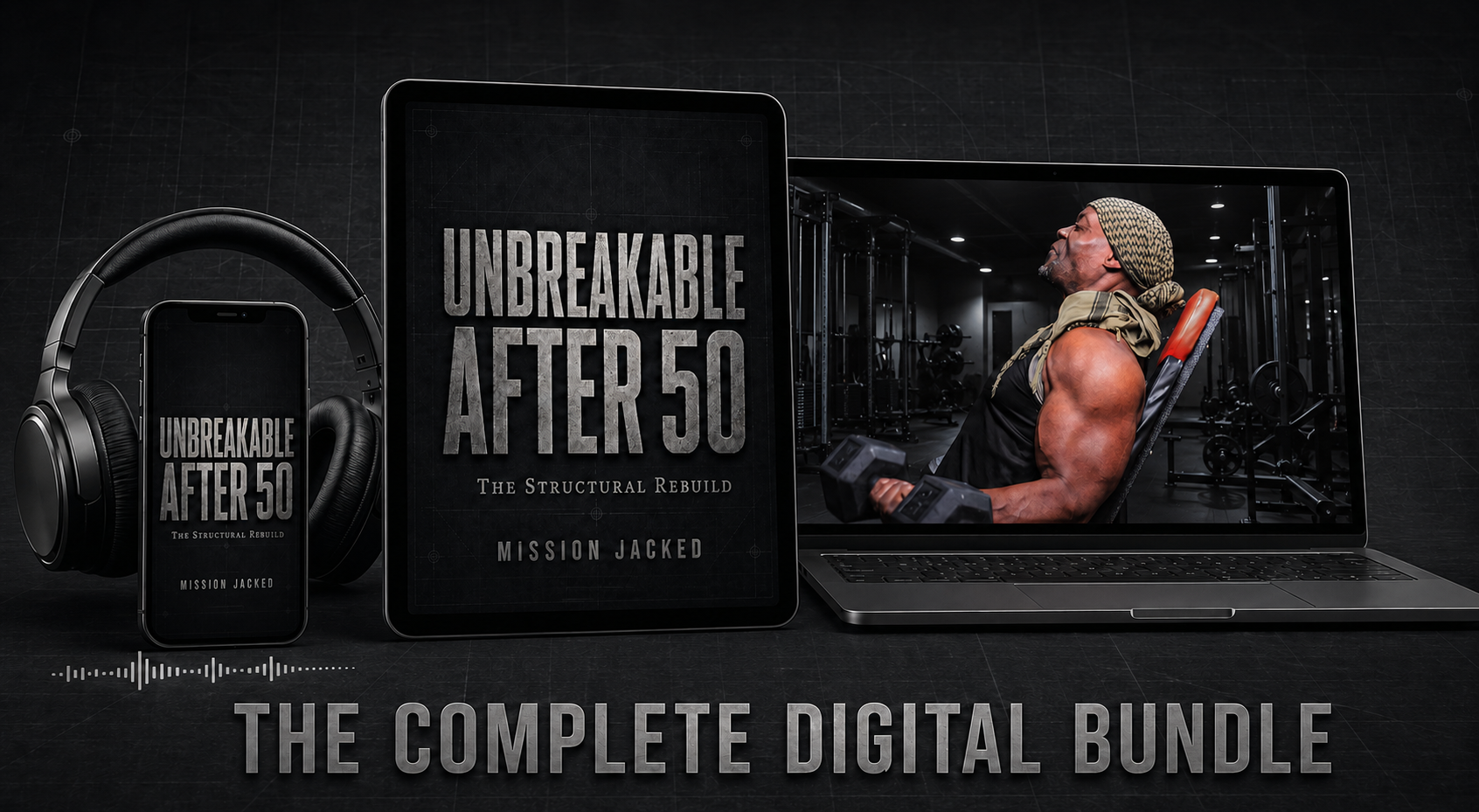 THE COMPLETE DIGITAL BUNDLE
Still hungry to build muscle—but tired of workouts that steal the rest of your week?
Give that effort a structure.
Get The Structural Rebuild eBook, the complete 74-chapter audiobook (9-Hours) and an 18-minute workout-plan video.
Read it. Listen to it. See the plan explained.
Build muscle. Keep something left for life.
EBOOK On Amazon ASIN: B0HJB7DMXP
 eBook On Amazon
eBook — EPUB + PDF
Read the adjustable EPUB on your phone or eReader, or use the fixed-layout PDF for easy reference on any device. CLICK HERE!
Audiobook
 Audiobook
Complete 74-Chapter Audiobook (9-Hours)
Listen through the BookFunnel app while walking, commuting or getting on with your day. CLICK HERE!
Audiobooks available on other platforms soon!
Available In Paperback and Hard Cover Soon!
Mission Jacked L.L.C
Address: 9407 NE Vancouver Mall Dr
STE 104 #1269
Vancouver, WA 98662 USA
Email: mission@missionjacked.com