Mission Jacked.com
Fatigue After 50:
Why Rest Is Not Fixing Your Energy
Written by Psymon H. — Mission Jacked, Muscle and Resilience After 50

Explore the Unbreakable After 50 Book
You go to bed tired.
You sleep.
Then you wake up feeling as if somebody forgot to recharge you.
The body is upright, but the energy is not there. The first coffee gets you moving. The second makes you feel almost normal. By early afternoon, the wheels start coming off again.
You tell yourself you need an earlier night.
So you get one.
And nothing really changes.
This is where fatigue after 50 becomes confusing. You are resting, but you are not recovering. You are spending time in bed, but you are not waking up rebuilt.
That does not automatically mean something serious is wrong. But it does mean the lazy answer—“you’re getting older”—is not good enough.
The Short Answer
Fatigue after 50 is not always caused by getting too little sleep. Poor sleep quality, chronic stress, excessive training, inconsistent nutrition, medication and underlying health conditions can all leave a man tired after a full night in bed. Persistent or worsening fatigue should be medically assessed.
You may not need more rest.
You may need to find out what keeps making that rest ineffective.
Why Fatigue After 50
Is Not Just a Lack of Sleep
There is a difference between feeling sleepy and feeling depleted.
Sleepiness pulls your eyes closed. A nap sounds good. Your body is asking for sleep.
Fatigue feels heavier.
Your mind is slower. Motivation drops. Ordinary tasks require more effort than they should. You may not even feel able to sleep—you simply feel as though there is less of you available.
The two can overlap, but they are not identical.
You can spend eight hours in bed and still wake up tired if your sleep is repeatedly interrupted, poorly timed or not deep enough to restore you.
The National Heart, Lung, and Blood Institute explains that sleep deficiency is not limited to getting too few hours. It can also mean sleeping at the wrong time, sleeping poorly or having a sleep disorder that prevents restorative sleep.
That matters because most men judge sleep only by the clock.
“I went to bed at ten and got up at six. That’s eight hours.”
Maybe.
But how often did you wake?
Did you snore heavily?
Did you stop breathing?
Did you get up several times to urinate?
Did alcohol make you unconscious without producing good sleep?
Did stress keep part of your mind working while the rest of you lay still?
Time in bed is not always the same as restorative sleep.
And poor sleep is only one possible contributor to low energy after 50.
Constant Fatigue in Men Over 50
Can Be Accumulated Load
Most men look for one culprit.
They blame testosterone.
They blame age.
They blame a vitamin deficiency, their workload or the fact that they trained legs two days ago.
Sometimes there is one clear cause. More often, fatigue is the result of several smaller loads arriving together.
Work stress is high.
Sleep quality slips.
Training remains aggressive.
Food becomes inconsistent.
A joint aches, so every movement costs a little more.
You start leaning harder on caffeine.
The caffeine delays sleep.
The poor sleep lowers your tolerance for stress.
The stress makes training feel heavier.
None of these problems seems large enough to explain how tired you feel. Together, they can change the way the entire week operates.
Imagine carrying a backpack while somebody adds one small plate at a time.
You cope with the first one.
Then another.
Then another.
Because each addition is small, you keep telling yourself the pack is manageable.
Eventually, a flight of stairs feels harder than it should. You blame the stairs.
The stairs are not the problem.
The total load is.
This is where fatigue begins to affect more than your energy. It changes whether your strength remains available when life needs it. That is the difference between merely possessing strength and being able to rely on it.
Stress and Fatigue After 50
Feed Each Other
Stress is not limited to panic, arguments or major life events.
Anything that demands adjustment adds load.
Work deadlines. Financial pressure. Poor sleep. Pain. Illness. Training. Dieting. Family responsibility. Even positive changes can demand energy from the same system.
The body does not neatly separate gym stress from work stress.
It responds to the total.
That is why the workout you handled easily during a quiet week can bury you during a difficult one. The exercises did not suddenly become dangerous. Your available capacity changed.
When stress remains high, men often respond by pushing harder.
They train to clear their head.
They add caffeine to maintain output.
They cut sleep to create more time.
They become stricter with food because discipline feels like the one thing they can still control.
Each decision looks productive in isolation. Together, they can make the system more brittle.
Then the man becomes irritated by small problems, loses concentration later in the day and needs longer to recover from training.
He thinks he has become lazy.
He has not.
He has failed to account for the load he is already carrying.
Why You Can Sleep and
Still Feel Tired After 50
A full night of poor-quality sleep can leave you feeling as though you barely slept.
One of the biggest mistakes men make is assuming that unconsciousness equals recovery.
It does not.
Alcohol can make you fall asleep faster while disrupting sleep later in the night. Pain can pull you into lighter sleep without fully waking you. Stress can keep the nervous system alert. Sleep apnea can repeatedly interrupt breathing and prevent restorative sleep, even when you have no memory of waking.
If you regularly snore heavily, wake with headaches or a dry mouth, gasp during sleep, struggle to stay awake during the day or never feel refreshed despite spending enough time in bed, do not simply buy another supplement.
Get it assessed.
That is not weakness. That is intelligent troubleshooting.
There is no medal for spending years trying to out-discipline an untreated sleep disorder.
Low Energy After 50
May Begin With Unstable Fuel
Food does more than fill the stomach.
It affects the availability and stability of energy across the day.
A man may eat too little because he is trying to lose fat, then wonder why his training collapses.
He may eat one enormous meal late at night because the day got away from him, then sleep poorly.
He may survive the morning on coffee, hit a wall in the afternoon and reach for whatever delivers the fastest lift.
That lift is usually followed by another drop.
This does not mean every energy crash is a blood-sugar disorder. It does mean that inconsistent meals, inadequate protein, aggressive calorie restriction and poorly placed carbohydrates can make energy harder to predict.
Insulin resistance and diabetes can also contribute to fatigue, but they require proper assessment—not guesswork based on a social-media checklist.
The National Institute of Diabetes and Digestive and Kidney Diseases explains that insulin resistance can lead to elevated blood glucose. Fatigue is also listed among the possible symptoms of diabetes.
If low energy comes with increased thirst, frequent urination, unusual hunger, blurred vision, unexplained weight change or slow-healing wounds, speak to a healthcare professional.
Do not turn a symptom into a diagnosis.
Use it as a reason to investigate.
Poor Recovery After 50
Can Be Caused by the Workout
Training should cost something.
A productive session creates fatigue. That is part of the process.
The problem begins when the cost repeatedly exceeds what you can recover from.
Some men still train according to the standards their body tolerated at 30.
More sets.
More exercises.
More days.
More intensity techniques.
The session feels serious, but the rest of the week pays for it.
Sleep becomes restless on training nights. Joints remain irritated. Performance drops from one workout to the next. Motivation disappears, and the man assumes he needs to become mentally tougher.
But if training regularly leaves you exhausted rather than adapted, more aggression is not the answer.
Training fatigue after 50 has to be judged by what happens after the workout.
Did performance improve by the next session?
Did the muscle recover?
Did sleep remain intact?
Did your normal energy return?
Could you still function outside the gym?
If the answer is repeatedly no, the workout is not proving your toughness.
It is exposing a recovery problem.
This is why training volume cannot be judged only by what you survive in the gym. It must be judged by what you can still do after you leave.
Explore the Unbreakable After 50 Book
Why Men Feel Tired After 50
While Doing “Everything Right”
This is the part that frustrates disciplined men.
They train.
They eat reasonably well.
They take supplements.
They try to sleep.
They walk.
They drink water.
From the outside, everything looks covered.
But “doing everything right” can still become too much when every good habit is performed aggressively.
Hard training is good, so you train harder.
Walking is good, so you chase more steps.
Eating less helps fat loss, so you cut harder.
Cold exposure is good, so you add it while already exhausted.
Fasting is good, so you extend it despite poor recovery.
Every tool has a cost.
The body does not award bonus points because the stress came from a healthy activity.
This is where men become overloaded by their own discipline.
They have built a collection of individually useful practices that no longer work together.
A good system is not a pile of good habits.
It is a structure in which those habits support one another.
Medical Causes of
Unexplained Tiredness After 50
Not every case of fatigue can be fixed by adjusting a bedtime routine or removing a few sets from your workout.
Persistent fatigue may be associated with sleep apnea, anemia, iron deficiency, thyroid conditions, low testosterone, diabetes, depression, medication side effects, persistent pain, infection and heart or lung conditions.
That list is not there so you can diagnose yourself.
It is there to stop you from assuming that every loss of energy is normal ageing.
The National Institute on Aging advises speaking with a healthcare professional when tiredness lasts for several weeks, interferes with normal activities or does not improve.
Pay particular attention when fatigue arrives suddenly, becomes severe or appears alongside chest pain, shortness of breath, fainting, unusual bleeding, fever, unexplained weight loss, significant weakness or a marked change in mood.
The objective is not to frighten you.
It is to stop you from normalising something that deserves investigation.
How to Increase Energy After 50
Without Chasing Another Stimulant
Before buying another powder, capsule or energy drink, establish what your current system is actually doing.
For seven days, track five things.
Track What Your Sleep Produces
Write down when you went to bed, when you woke, how often you remember waking and how you felt during the first hour of the morning.
Do not grade sleep only by duration.
Grade the result.
Record Your Total Daily Load
At the end of each day, rate your total stress from one to ten.
Include work, relationships, pain, poor sleep and training.
The body has already added them together. Your notes should do the same.
Measure the Cost of Each Workout
Record how you feel later that day, the following morning and before your next workout.
If every session creates a multi-day hole, the problem is not motivation.
The dose may be wrong.
Look for Food and Energy Patterns
You do not need to weigh every crumb.
Notice when you eat, whether each meal contains meaningful protein and whether the energy crash follows long gaps, oversized meals or heavily processed food.
Look for patterns before creating rules.
Record When You Use Caffeine
Write down the amount and the time.
Many men use caffeine to cover fatigue, then sleep poorly and require more caffeine the next day.
That is not energy.
It is borrowing.
After one week, look at the whole page rather than one isolated symptom.
Where is the load entering?
Where is recovery being interrupted?
What are you repeatedly using to hide the problem?
That is where the useful work begins.
Fatigue After 50 Is Information,
Not a Character Flaw
Fatigue is not always a sign that you need to stop.
Sometimes it is the normal cost of meaningful effort.
But persistent fatigue is information.
It may be telling you that sleep quality is poor.
That training volume is too high.
That food intake is inconsistent.
That stress is outpacing recovery.
That pain is taking more from you than you admit.
Or that something medical needs to be assessed.
The mistake is not feeling tired.
The mistake is refusing to investigate because you think a strong man should be able to push through it.
There comes a point where pushing through stops being resilience and becomes avoidance.
You do not prove your strength by ignoring the warning light.
You prove it by finding out why it came on.
Rebuilding Energy After 50
Means Reducing Competition
Your body cannot rebuild well when every part of your life is fighting for the same recovery.
Training should support sleep—not destroy it.
Nutrition should support energy—not create another cycle of restriction and rebound.
Walking should restore you—not become another target you feel guilty for missing.
Supplements should fill a specific gap—not become a replacement for investigation.
The goal is not to remove every demand from your life. That is impossible.
The goal is to build enough capacity that ordinary demands no longer feel like emergencies.
That starts by removing the loads that produce no return.
Unnecessary training volume.
Late caffeine.
Alcohol disguised as relaxation.
Chaotic eating.
Revenge bedtime procrastination.
The habit of saying yes when your system is already overloaded.
You may not need to do more.
You may need to stop spending energy on things that are not rebuilding you.
Common Questions
About Fatigue After 50
Is Fatigue Normal After 50?
Occasional tiredness after physical effort, emotional stress or poor sleep can be normal. Persistent fatigue that affects daily life or does not improve with rest should not automatically be blamed on ageing.
Why Am I Tired After Eight Hours of Sleep?
Sleep quality matters as much as time in bed. Sleep apnea, pain, alcohol, stress, repeated waking and other sleep disorders can leave you unrefreshed despite spending enough hours in bed.
Can Excessive Training Cause Fatigue After 50?
Yes. When training stress repeatedly exceeds your ability to recover, energy, sleep, performance and motivation can deteriorate. The effect of a workout should be judged by what it produces—not merely by how hard it felt.
When Should I See a Doctor About Fatigue?
Seek medical assessment when fatigue persists for several weeks, becomes worse, interferes with normal activities or appears with other unexplained symptoms.
Fatigue After 50 Is Only One Part of the Structure
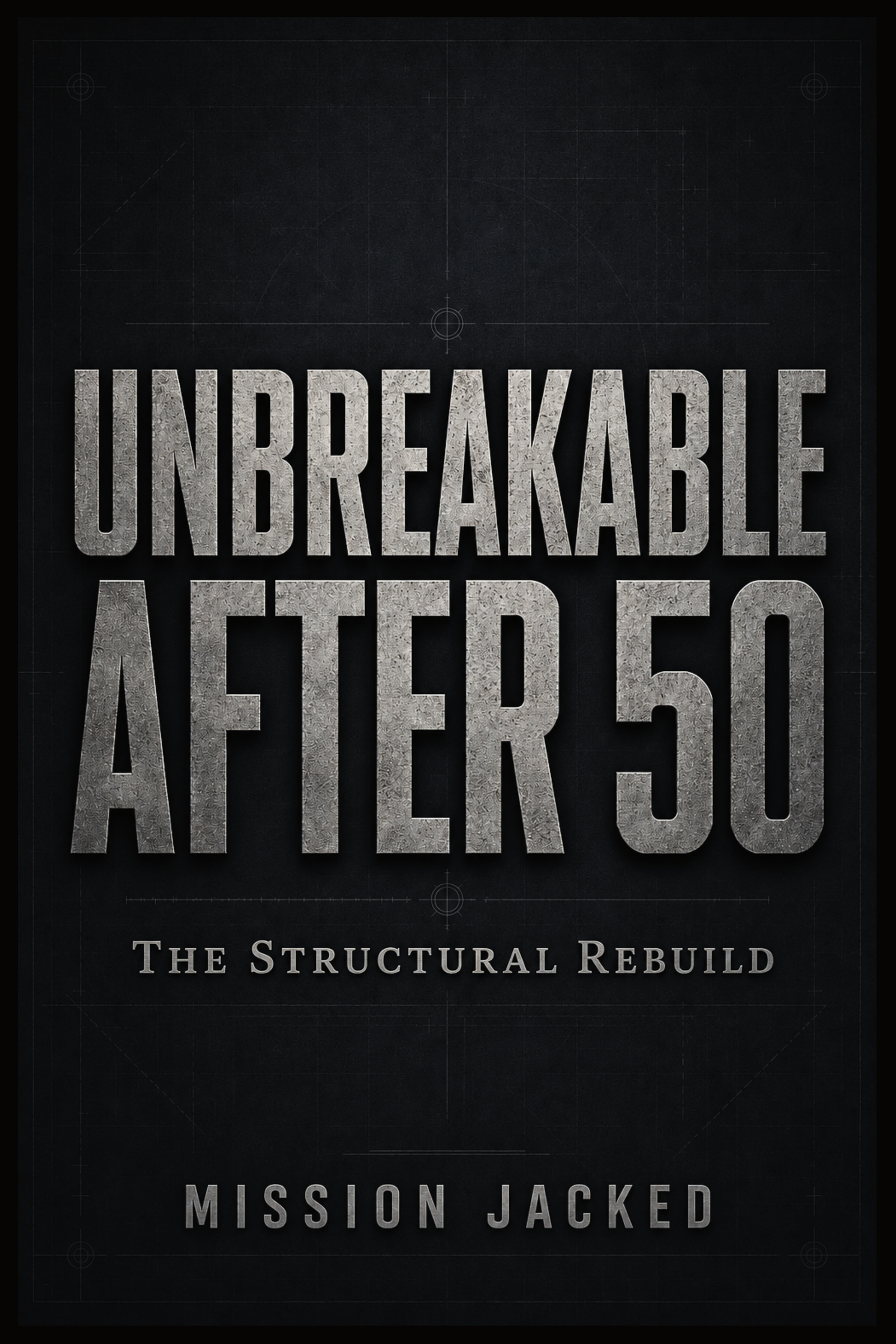
Unbreakable After 50: The Structural Rebuild explains why energy, sleep, stress, nutrition, inflammation, recovery and training cannot be repaired as separate problems.
Across 74 chapters, the book gives men over 50 a complete framework for rebuilding the system beneath their strength.
Not another collection of isolated tips.
One structure.
You can also read Chapter One free and discover why strength after 50 must be judged by reliability—not memory.


Click Here To Explore This Book Today
About Psymon H.
Psymon H. is the founder of Mission Jacked and a Muscle and Resilience After 50 coach. After more than four decades of training—and rebuilding his own body around serious injuries—his work focuses on helping men develop muscle, recovery capacity and structural strength that remain useful outside the gym.
His approach is not built around aesthetics, ego lifting or proving how much punishment a man can survive.
It is built around becoming harder to break.
Mission Jacked L.L.C
Address: 9407 NE Vancouver Mall Dr
STE 104 #1269
Vancouver, WA 98662 USA
Email: mission@missionjacked.com