Mission Jacked.com
Protein Intake After 50:
Why Protein Alone Isn’t Enough to Build Muscle

Written by Psymon H. — Mission Jacked, Muscle and Resilience After 50
You eat the eggs.
You drink the shake.
You count every gram.
By the end of the day, the protein target has been hit.
So why is your muscle not answering?
That is the question more men should be asking.
Protein has become the safest answer in fitness because it sounds scientific and requires very little examination.
Not building muscle?
Eat more protein.
Losing strength?
Add another shake.
Recovery feels poor?
Buy a larger tub.
Eventually, a man can consume enough protein to supply a small construction site while his training produces no reliable evidence that anything is being built.
That does not mean protein is unimportant.
It means raw material is being confused with instruction.
Protein supplies the amino acids used to repair and build tissue. It cannot decide which muscle needs to adapt. It cannot make a weak set precise. It cannot correct a training schedule that keeps interrupting recovery. It cannot force the body to add muscle simply because an app says the daily target has been reached.
Weight training after 50 must create the demand.
Protein helps the body answer it.
Reverse those roles and the entire strategy becomes dishonest.
Click Here To Explore The New Book - Unbreakable After 50
The Short Answer
Protein intake after 50 supports muscle repair and growth, but protein alone does not provide the mechanical stimulus required to build muscle. Ageing muscle can also become less responsive to small protein servings, making total intake, per-meal dose, protein quality and resistance training more important. The objective is not to consume the largest possible number of grams. It is to combine sufficient protein with a clear muscular demand and enough recovery for adaptation to occur.
Protein Does Not Build
Muscle by Itself
Let us remove the first piece of nonsense.
Protein does not travel through the body looking for an empty sleeve to fill.
After digestion, dietary protein provides amino acids. Those amino acids have many possible jobs. They are used throughout the body to support enzymes, hormones, immune proteins, organs and tissue repair.
Muscle growth is one possible destination.
It is not an automatic delivery address.
To build muscle, the body must receive a reason to invest in more contractile tissue. Resistance training can provide that reason by challenging muscle beyond what its current capacity can comfortably handle.
The training signal and the nutritional supply then work together.
Training creates the assignment.
Protein provides material for the response.
Without adequate protein, the response may be limited.
Without adequate muscular demand, more protein cannot manufacture the missing assignment.
A 2025 network meta-analysis involving adults aged 50 and older found that combining resistance training with protein supplementation was more effective for several muscle outcomes than protein supplementation alone. Resistance training—alone or combined with protein—also improved strength and physical function more than protein supplementation by itself. Protein, resistance training and muscle outcomes in older adults
That is the hierarchy.
Protein matters.
But muscle still needs a reason to remain expensive.
Why Protein Intake After 50
Deserves More Attention
The answer is not that protein suddenly becomes useless when you turn 50.
The body does not tear up the contract on your birthday.
The problem is that ageing muscle can become less responsive to small anabolic signals. Researchers commonly call this anabolic resistance: a reduced muscle-protein-synthesis response to stimuli such as protein intake and exercise.
That phrase is often abused.
Anabolic resistance does not mean your muscles are incapable of growing.
It does not mean protein has stopped working.
It means a weak or incomplete signal may no longer produce the response it once did.
Research comparing younger and older men found that older men required a larger relative protein dose in a meal to maximise the post-meal muscle-protein-synthesis response. The estimated plateau occurred around 0.40 grams of protein per kilogram of body weight for the older men, compared with approximately 0.24 grams per kilogram for the younger group. Protein dose response in younger and older men
That does not create a universal prescription for every man over 50.
It reveals the direction of the problem.
A token serving may no longer be enough.
Ten grams here.
A yoghurt there.
A small amount of meat buried beneath a mountain of carbohydrates.
The daily total may look respectable once every trace of protein has been counted, but the meals themselves may never deliver a strong enough amino-acid rise to create a useful response.
After 50, vague nutrition produces vague returns.
Anabolic Resistance Is
Not a Protein Deficiency
This distinction matters because men hear “anabolic resistance” and immediately reach for a larger scoop.
That may not be the missing piece.
Anabolic resistance is influenced by more than the amount of protein on the plate. Physical inactivity, prolonged sitting, illness, inflammation and poor metabolic health can all affect how muscle responds to nutrition and exercise.
Resistance training itself helps sensitise muscle to amino acids.
Movement matters.
Muscle use matters.
The condition of the system matters.
This is why treating protein as an isolated solution is too small for the problem.
You cannot out-supplement a body that receives no serious muscular demand.
You cannot expect a shake to repair training that is built around momentum, joint irritation and systemic exhaustion.
You cannot pour more material onto a site where the workers never received clear plans.
The issue is not always insufficient supply.
Sometimes the instruction is trash.
Your Daily Protein Total
Can Hide a Weak Structure
Most men judge protein by one number.
The daily total.
One hundred and twenty grams.
One hundred and fifty grams.
Two hundred grams.
That number matters, but it can hide how the protein was consumed.
Imagine a man who eats very little protein at breakfast, slightly more at lunch and most of it during one enormous evening meal.
He may hit his daily target.
But he has not necessarily created several well-constructed opportunities to stimulate muscle protein synthesis across the day.
Now imagine another man eating sufficient, high-quality protein across three deliberate meals.
The same total can create a different feeding pattern.
The long-term importance of perfectly even protein distribution is not completely settled. Some reviews support balanced meals, while other research suggests total daily intake remains the dominant factor.
That uncertainty must be stated honestly.
Meal distribution is not magic.
But repeatedly eating meals too small to create a meaningful response is a weak strategy—especially when ageing muscle is less sensitive to low protein doses.
A practical review of protein and ageing suggests that meals containing roughly 25–30 grams of protein, or around 0.4 grams per kilogram, can be useful targets for older adults. The exact requirement changes with body size, protein quality, health and the rest of the meal. Protein and ageing: practical considerations
The objective is not to worship the number.
It is to stop pretending that five grams of protein at breakfast has the same muscular value as a properly constructed meal.
Click Here To Explore The New Book - Unbreakable After 50
How Much Protein Do
Men Over 50 Need?
There is no honest number that fits every man.
Body size matters.
Training status matters.
Energy intake matters.
Health matters.
Whether you are maintaining weight, losing fat or recovering from illness matters.
The standard adult Recommended Dietary Allowance of 0.8 grams per kilogram per day is designed as a general minimum to meet the needs of most healthy adults. It is not a muscle-building target created for resistance-trained men over 50.
Evidence reviews commonly propose higher intakes for older adults, particularly those who train or are trying to preserve lean tissue. A large 2022 systematic review and meta-analysis found that additional protein produced small gains in lean body mass during resistance training, with a significant effect among adults aged 65 and older consuming approximately 1.2–1.59 grams per kilogram per day. Protein intake during resistance training
For many healthy men over 50 who train seriously, a practical starting range is approximately 1.2–1.6 grams of protein per kilogram of body weight per day.
That is a range.
Not a commandment.
A man carrying substantial excess body fat may find that calculating from current body weight creates an unnecessarily high target. Goal weight, estimated lean mass and professional dietary judgement may provide a more useful starting point.
Men with kidney disease or another medical condition that affects protein intake should obtain guidance from a qualified healthcare professional rather than copying a number from a fitness video.
More is not automatically better.
The goal is sufficient protein—not competitive eating with a shaker bottle.
Why More Protein Can
Stop Producing More Return
Once protein intake is adequate, adding more may produce little additional muscle gain.
That point destroys a profitable fantasy.
Supplement companies benefit when you believe every stalled result is caused by an empty tub.
Research is less convenient.
A systematic review of non-frail, community-dwelling older adults found that protein supplementation alone did not significantly improve lean mass, strength or physical performance. The researchers noted that many participants already consumed sufficient habitual protein. Protein supplementation in non-frail older adults
Other meta-analyses have found benefits when protein is combined with resistance training.
Those findings are not contradictory.
They expose context.
Protein can help when intake is insufficient, when the training creates an adaptive demand or when the population has particular nutritional needs.
But once the nutritional gap has been closed, another scoop may not be the limiting factor.
Your exercise may be poorly standardised.
Your target muscle may be escaping the movement.
Your progression may exist only because repetitions became faster.
Your training volume may be draining the recovery needed to convert stimulation into adaptation.
Your sleep may be wrecked.
The answer to every one of those problems is not whey.
Leucine Is a Trigger,
Not a Construction Crew
Leucine is an essential amino acid that plays an important role in initiating the signalling involved in muscle protein synthesis.
This has led to another oversimplification:
If leucine switches on the process, more leucine must build more muscle.
Not necessarily.
A light switch can illuminate a construction site.
It cannot build the wall.
Leucine helps initiate the signal, but muscle protein synthesis also requires the other essential amino acids. That is why a complete protein source matters.
Studies have shown that adding leucine to a smaller protein serving can strengthen the acute muscle-protein-synthesis response. In older men, leucine enrichment improved the anabolic response to a suboptimal protein dose after resistance exercise. Leucine-enriched protein after resistance exercise
But that does not mean free-form leucine must be added to every meal.
A well-constructed serving of high-quality protein may already provide enough.
A 2024 review reported that meals supplying roughly 2.8 grams of leucine—often available from around 30 grams of high-quality protein—can stimulate muscle protein synthesis in older adults. The same review warned that the long-term effect of protein distribution and leucine thresholds on muscle mass remains less certain than the acute response. Protein quantity, distribution and leucine
That qualification matters.
Acute muscle protein synthesis is evidence of a biological response.
It is not a photograph of guaranteed future muscle.
Do not turn leucine into another magic powder.
Use it to understand why the quality and size of each protein serving matter.
Protein Quality Matters—
but the Argument Is Usually Oversold
Protein quality refers partly to digestibility and the amount and balance of essential amino acids a source provides.
Animal proteins such as eggs, dairy, meat and fish generally provide all essential amino acids in useful proportions.
That does not make plant protein useless.
It means plant-based meals may require more deliberate planning. A larger total serving, a blend of complementary sources or a protein isolate can help provide sufficient essential amino acids and leucine.
The body does not care whether the label matches somebody’s nutritional tribe.
It cares what arrives after digestion.
Whey is useful because it is convenient, highly digestible and leucine-rich.
It is not mandatory.
Eggs are useful.
They are not magical.
Meat is useful.
It does not excuse the absence of vegetables, fibre or an appropriate energy intake.
Protein quality should improve the plan.
It should not become another identity argument.
Whole Food and Protein Powder
Have Different Jobs
Protein powder is food processed for convenience.
It can help a man reach an appropriate intake when appetite, schedule or meal structure makes that difficult.
It can also become a nutritional hiding place.
Three shakes may hit the target while the rest of the diet remains empty, low in fibre and poorly constructed.
Whole foods generally provide more than isolated protein. Depending on the source, they can supply iron, zinc, vitamin B12, calcium, essential fats and other nutrients.
Powder solves a logistical problem.
It should not automatically replace meals.
Use the tool according to the job.
If breakfast is consistently low in protein, a shake may repair it.
If you struggle to eat after training, whey may be practical.
If your daily intake is already sufficient, another shake is not evidence of greater commitment.
It may simply be expensive urine and extra calories.
Click Here To Explore The New Book - Unbreakable After 50
Does Protein Timing Matter After 50?
The fitness industry turned the post-workout period into an emergency.
Finish the final repetition.
Run for the shaker.
Miss the window and the workout disappears.
That is theatre.
Resistance exercise can increase the muscle’s sensitivity to protein for many hours. Total daily intake and consistent meal structure matter more than beating a stopwatch by five minutes.
That does not make timing irrelevant.
If you trained after several hours without eating, consuming a protein-rich meal or shake soon afterwards is sensible.
If you ate a substantial protein-containing meal shortly before training, the situation is different.
Protein around the session is useful because it places amino acids near a period of increased muscular demand.
But “near” is not a ten-minute panic window.
Build a repeatable day.
Do not turn nutrition into an ambulance chase.
Protein Cannot Rescue a
Weak Training Signal
This is where the argument returns to the iron.
You can eat perfectly and still train badly.
If momentum carries the resistance, the target muscle receives less controlled demand.
If the exercise ends because a joint becomes irritated, the muscle may never reach a useful limit.
If every workout changes, progression becomes difficult to measure.
If extra sets produce only general exhaustion, you increase recovery cost without confirming a stronger signal.
Protein cannot identify the muscle you intended to train.
It cannot separate useful fatigue from chaos.
It cannot make six dishonest repetitions equal six controlled ones.
This is why my training revolves around a defined cadence, sustained tension and a performance that can be compared when the exercise returns.
The method is not designed to make protein unnecessary.
It is designed to give the protein somewhere useful to go.
The set creates a clear demand.
Nutrition supports the response.
Recovery allows the response to finish.
Remove any one of those and the structure weakens.
Protein Cannot Rescue Poor Recovery
Men often treat recovery as another nutritional problem.
Sore for too long?
More protein.
Strength falling?
More protein.
Energy flat?
More protein.
But recovery includes more than tissue repair.
The nervous system must regain readiness.
Sleep must remain stable.
Joint irritation must settle.
Energy must return.
The next session must arrive when another useful performance can be produced.
If training repeatedly creates more fatigue than you can recover from, meeting your protein target does not erase the debt.
The body is not refusing the amino acids.
The programme is spending recovery faster than you can replace it.
Your muscle rested.
That does not mean you did.
Protein Cannot Rescue an Energy
Deficit That Is Too Aggressive
Building or preserving muscle requires energy as well as amino acids.
A man trying to lose fat may increase protein and then cut calories so hard that training performance, sleep and recovery collapse.
High protein intake can help preserve lean tissue during weight loss.
It cannot make an extreme deficit free.
The faster you demand weight loss, the harder it becomes to maintain training quality and lean mass—particularly if you are already relatively lean or highly trained.
The objective after 50 should not be to make the scale surrender at any cost.
It should be to remove fat while protecting the structure you spent years building.
Protein helps.
An intelligent energy deficit decides whether the plan is survivable.
A Practical Protein Structure
for Men Over 50
You do not need to turn every meal into a laboratory.
You need a structure strong enough to expose where the gaps are.
Establish a Sensible Daily Range
For many healthy, resistance-trained men over 50, approximately 1.2–1.6 grams per kilogram per day is a practical starting range.
It may need to change according to body composition, total calories, health, training demand and goals.
Build Meals Around a Real Protein Source
Do not sprinkle small amounts of protein across meals and hope the daily total saves them.
Start with the protein source.
Then build the rest of the meal.
Give Each Main Meal Enough Weight
A rough target of 0.4 grams per kilogram per meal can be useful for older adults, but it is not a biological border patrol.
For many men, 30–40 grams of high-quality protein in each main meal is a practical working target.
Larger men may need more.
Smaller men may need less.
Use Shakes to Repair Gaps
A shake is useful when a meal falls short or convenience matters.
It should solve an identified problem—not become a reflex.
Include Protein Near Training Without Panicking
Eat a protein-containing meal within a practical period before or after the session.
The exact timing depends on when you last ate and what you can tolerate.
Record What the Entire System Produces
Do not judge the plan by grams alone.
Track:
- controlled training performance;
- body weight and waist trend;
- muscle retention or growth;
- appetite and digestion;
- energy;
- sleep;
- and recovery between sessions.
The protein target serves the result.
The result does not serve the target.
Signs Protein May Not Be Your Limiting Factor
Your protein intake may already be adequate if:
- you consistently consume sufficient protein for your body size and goals;
- your meals contain substantial, high-quality protein servings;
- your body weight is stable or moving according to plan;
- and increasing protein has not improved performance, recovery or body composition.
Look beyond protein if:
- your exercise execution changes every session;
- your target muscles are not progressing;
- joint pain ends sets before muscular fatigue;
- you train again before performance has recovered;
- sleep is poor;
- calories are excessively low;
- or your programme produces exhaustion without measurable progression.
Do not keep turning the same dial when the fault is elsewhere in the machine.
Common Questions About
Protein Intake After 50
How Much Protein Should a
Man Over 50 Eat to Build Muscle?
There is no universal intake. For many healthy men performing resistance training, approximately 1.2–1.6 grams per kilogram of body weight per day is a reasonable starting range. Body composition, calorie intake, health and training demand must be considered. Men with medical conditions affecting protein metabolism or kidney function should seek qualified guidance.
Is 100 Grams of Protein
Enough After 50?
It depends on body size, goals and total energy intake. One hundred grams may be sufficient for one man and inadequate for another. Judge protein relative to the individual—not as an isolated number.
Is 200 Grams of Protein Too
Much for a Man Over 50?
It may be unnecessary for many men. A high intake is not automatically harmful in a healthy person, but more protein does not guarantee more muscle. The appropriate amount depends on body size, health, total diet and training. Existing kidney disease requires professional guidance.
How Much Protein Should
I Eat at Each Meal?
Research in older adults supports using approximately 0.4 grams per kilogram per meal as a practical reference. For many men, that means roughly 30–40 grams of high-quality protein in a main meal, although individual needs vary.
Do Men Over 50 Need More
Protein Than Younger Men?
Older muscle can be less responsive to small protein servings, so higher per-meal and daily intakes may be useful. That does not mean every older man must consume extreme amounts.
What Is Anabolic Resistance?
Anabolic resistance is a reduced muscle-protein-synthesis response to anabolic stimuli such as dietary protein and exercise. It does not mean muscle growth is impossible. A sufficient protein dose, resistance training and improved physical activity can strengthen the response.
Is Leucine Necessary for
Building Muscle After 50?
Leucine helps initiate muscle-protein-synthesis signalling, but it works best as part of a complete supply of essential amino acids. High-quality protein foods often provide sufficient leucine without separate supplementation.
Should I Take Leucine
With Every Meal?
Not automatically. If a meal already contains enough high-quality protein, additional leucine may provide little benefit. Leucine can strengthen a smaller or lower-leucine protein serving, but it should not replace complete protein.
Is Whey Protein Better Than Food After 50?
Whey is convenient, digestible and rich in leucine. Whole food provides protein alongside other nutrients. Neither must defeat the other. Use whole food as the foundation and whey when it solves a practical intake problem.
Do I Need Protein Immediately After Training?
No. There is no tiny post-workout window that closes within minutes. Consuming protein within a practical period around training is sensible, especially if you have not eaten for several hours, but total daily intake and consistent meals matter more than panic timing.
Can Protein Build Muscle
Without Weight Training?
Adequate protein helps maintain tissue and supports general health, but meaningful muscle growth usually requires a progressive muscular stimulus. Protein supplementation alone is not a replacement for resistance training.
Can I Build Muscle in a Calorie Deficit After 50?
It is possible, particularly for beginners, detrained men or those carrying substantial body fat. But the larger and longer the calorie deficit, the harder muscle gain and recovery become. Protein and resistance training help protect lean tissue; they do not make aggressive dieting cost-free.
Protein Intake After 50 Is
Only One Part of the Structure
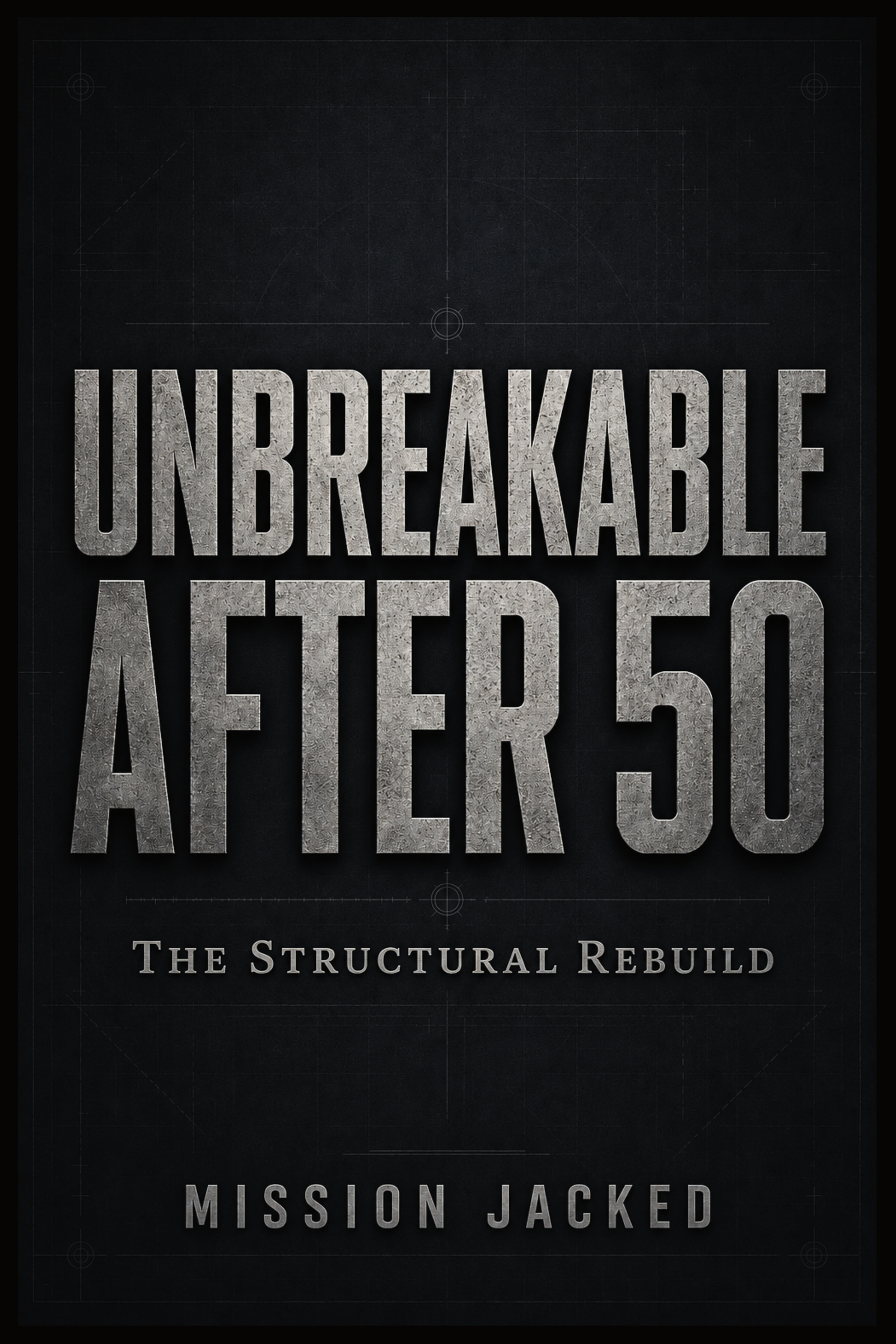


Unbreakable After 50: The Structural Rebuild explains why training, recovery, muscular tension, joint integrity, energy and nutrition cannot be rebuilt as separate problems.
Across 74 chapters, the book gives men over 50 a complete framework for replacing disconnected tactics with a system their body can answer.
Not another protein target.
A structure that tells the protein what it is supporting.
You can also read Chapter One free and discover why strength after 50 must be judged by reliability—not memory.Choose How You Want to Experience the Book
Receive the complete ebook, the full audiobook narrated by Psymon H. and the private Two-Day Training System video.
GET THE COMPLETE DIGITAL BUNDLE
One payment. No subscription.
The book builds the understanding.
The video gives you a place to start.
About Psymon H.
Psymon H. is the founder of Mission Jacked and a Muscle and Resilience After 50 coach. After more than four decades of training—and rebuilding his own body around serious injuries—his work focuses on helping men develop muscle, recovery capacity and structural strength that remain useful outside the gym.
His approach is not built around aesthetics, ego lifting or proving how much punishment a man can survive.
It is built around becoming harder to break.
Mission Jacked L.L.C
Address: 9407 NE Vancouver Mall Dr
STE 104 #1269
Vancouver, WA 98662 USA
Email: mission@missionjacked.com