Mission Jacked.com
Strength After 50: Why You Feel Strong Until Strength Is Actually Required

Most men do not wake up one morning and suddenly realise they have lost their strength.
It happens more quietly than that.
You still look capable. You can still move a respectable weight. You still handle your own business. And because nobody has officially taken your strength away, you assume it is still there whenever you need it.
But strength after 50 is not measured only by what you can lift when you are rested, prepared and operating on your own terms.
It is measured at the end of a long day.
When you slept badly.
When work has already taken something out of you.
When somebody needs your help and you do not get to choose the timing.
That is when strength stops being an idea and becomes evidence.
The question is not whether you still possess muscle.
The question is whether your strength remains available when life places a real load on it.
Why Past Strength After 50 Can Create False Confidence
A man who has trained, worked and carried responsibility for decades has every right to remember what he built.
The problem begins when yesterday’s strength is used as proof of today’s readiness.
You remember the weights you moved. The long shifts you worked. The pressure you handled without falling apart. Those memories become part of your identity.
You were the strong one.
The dependable one.
The man who got things done.
And somewhere along the way, that identity can stop being tested.
You continue to believe you are strong because the evidence once existed. But strength that only survives in memory is no longer a working asset. It is part of your history.
That does not mean everything has disappeared.
It means the gap between what you believe you can do and what your present system can reliably produce may be growing.
This is why losing strength after 50 is so easy to miss. You do not necessarily become visibly weak. You simply become less dependable under pressure.
Strength After 50 Is Not
the Same as Readiness
You can still have muscle and lack readiness.
You can still train and lack readiness.
You can even become stronger in a specific exercise while becoming less capable across the rest of your life.
Think of a powerful car with a failing battery. The engine has not disappeared. The potential is still sitting there. But when you turn the key, the system cannot consistently bring that power online.
The same thing happens to men.
Poor sleep blunts concentration and physical output.
Unmanaged stress keeps the nervous system running hot.
Training adds fatigue faster than the body can clear it.
Meals become inconsistent. Energy becomes unpredictable. Small aches change how you move. Patience gets shorter because the system is carrying more load than you realise.
Nothing appears catastrophic.
That is why it is dangerous.
You can function well enough to believe there is no problem while your margin for handling additional pressure continues to shrink.
Readiness means your strength is available without requiring perfect conditions.
If everything has to line up before you feel capable, your strength may still exist—but your reliability is already compromised.
Functional Strength After 50 Means Remaining Reliable
Functional strength is often reduced to exercises that imitate daily activities.
Carries. Step-ups. Squats. Rotational movements.
Those exercises may have value, but real-world strength is bigger than movement selection.
Functional strength after 50 means being useful when the conditions are inconvenient.
Can you stay clear-headed when you are tired?
Can you carry something awkward without your back feeling fragile for the next three days?
Can you remain patient when pressure is coming from several directions?
Can you help somebody without resenting the fact that they needed you?
Can you make a sound decision when you would rather switch off?
That is reliability.
People do not rely on the weight you can lift under controlled conditions. They rely on the man who shows up when the conditions are not controlled.
They need your judgement.
Your steadiness.
Your physical capability.
Your ability to absorb pressure without spreading it across everyone else.
Reliability is strength that survives contact with real life.
The Slow Loss of Strength
After 50 Most Men Miss
The decline usually begins with negotiation.
You skip the walk because the weather is poor.
You put off the mobility work because nothing hurts badly enough yet.
You sleep badly, then force a hard workout because missing it would make you feel weak.
You rely on caffeine to cover the energy crash.
You stop preparing food and start eating whatever is easiest.
You become irritable when tired and tell yourself it is just a difficult week.
One difficult week becomes your normal operating condition.
This is how men begin losing strength after 50 without recognising it.
It is rarely one dramatic failure. It is a gradual reduction in reserve.
You can still do what needs to be done—but it takes more from you.
You can still train—but recovery spills into the rest of the week.
You can still handle pressure—but everybody around you feels the cost.
Your margin is disappearing.
A younger body can often absorb poor sleep, excessive training and badly managed stress without immediately exposing the damage. After 50, the body becomes less willing to hide the bill.
That is not punishment.
It is information.
The system is telling you that effort alone is no longer enough.
Five Questions That Reveal Your Real Strength After 50
Forget your best lift for a moment. Forget how muscular you look under good lighting.
Ask yourself five harder questions.
1. Is Your Strength After 50 Available When You Are Tired?
Anyone can feel capable at the beginning of a good day.
The real test comes after work, poor sleep, travel, stress or an unexpected demand.
You do not need to perform at your absolute best every hour. But you should still be able to function without becoming physically useless or emotionally volatile.
2. Does Pressure Improve or Destroy Your Decision-Making?
When two or three problems arrive together, can you decide what matters first?
Or do you become reactive, impatient and scattered?
Mental clarity is part of strength. A powerful body attached to an unreliable decision-maker is not a strong system.
3. Is Your Energy Predictable After 50?
You should not need to guess which version of yourself will appear each afternoon.
If your energy regularly crashes, your training performance swings wildly or basic responsibilities feel different from one day to the next, something underneath the surface needs attention.
Predictable energy is one of the foundations of staying strong after 50.
4. Is Training for Strength After 50 Improving Your Life?
Training should increase your capacity.
It should not leave you too drained to walk, work, sleep properly or remain present with your family.
Soreness is not automatically evidence of progress. Exhaustion is not proof that the workout was effective.
The right question is simple:
Is your training giving more back than it takes?
5. Do People Still Move Toward You When Something Goes Wrong?
This question cuts deeper than a strength test.
When pressure arrives, do people seek your help—or do they quietly work around you?
Your family may recognise your declining capacity before you do. They notice the irritability, fatigue, pain and short patience that you have started calling normal.
That is not an attack on your identity.
It is evidence about your current structure.
Why Training Harder After 50 Can Reduce Your Capacity
Many men respond to declining capacity by increasing effort.
They add another training day.
Another set.
Another exercise.
They shorten recovery because resting feels like retreating.
This approach makes emotional sense. You feel something slipping, so you grip harder.
But the body does not reward effort simply because the effort was sincere.
Training is a stress. It only becomes useful when you can recover from it and adapt.
If a workout leaves you depleted for days, disrupts your sleep, irritates your joints and reduces your ability to function, it has not strengthened the whole man.
It has taken capacity from one part of your life and spent it somewhere else.
That does not mean training after 50 should become easy.
Easy training without sufficient stimulus solves nothing.
The answer is precision.
Use enough muscular tension to create a reason for adaptation. Remove the unnecessary volume that creates fatigue without improving the signal. Allow enough recovery for the body to finish what the workout started.
The goal is not to survive more training.
The goal is to produce more from the training you perform.
How to Rebuild Strength and Resilience After 50
You do not rebuild reliability by attacking every problem separately.
Sleep affects recovery, appetite, concentration and physical output.
Training affects inflammation, nervous-system demand, energy and sleep.
Nutrition affects recovery, mood and your ability to produce force.
Stress changes how you respond to all of them.
These systems are connected. If they continually compete with one another, your capacity shrinks. If they begin supporting one another, the margin starts returning.
Begin with four standards.
Build Strength After 50 Without Draining the System
Your training should create a clear stimulus without burying it under exhaustion.
More work is not automatically better work.
You should leave the gym knowing exactly what you asked the muscle to do—not simply relieved that the punishment has ended.
Protect Recovery After 50
Recovery is not the absence of training.
It is the period in which training earns its value.
If you interrupt that process because you feel guilty for resting, you are not demonstrating discipline. You are preventing adaptation.
Create Predictable Energy After 50
Eat consistently enough to support your workload. Move daily. Pay attention to the patterns behind your crashes instead of repeatedly covering them with stimulants.
A reliable man needs reliable energy.
Practise Strength
Under Ordinary Pressure
Do not wait for a crisis to test your composure.
Notice how you respond to small delays, poor sleep, inconvenience and competing demands.
These moments reveal where your system loses control.
Steadiness is not a personality trait you either possess or lack. It can be trained—but only if you stop pretending that reactivity is normal
How to Maintain Strength After 50 When Life Gets Heavy
The strongest plan is not the one that works during a perfect week.
It is the one that survives the real one.
Work runs late.
Sleep gets interrupted.
Family responsibilities increase.
A joint becomes irritated.
Motivation disappears.
A reliable structure bends without collapsing. It allows you to reduce training when recovery is poor, adjust the load without protecting your ego and return to the standard without turning one difficult day into a lost month.
Maintaining strength after 50 is not about operating at maximum intensity all year.
It is about preserving the ability to act.
Some days that means training hard.
Some days it means walking, eating properly and going to bed.
The weak system only recognises effort when it hurts.
The reliable system recognises what the moment requires.
The New Standard for Staying Strong After 50
Earlier in life, strength may have been about proving what you could do.
How much could you lift?
How hard could you work?
How much discomfort could you tolerate?
After 50, the standard changes.
Strength becomes about being.
Being prepared.
Being consistent.
Being physically useful.
Being the man others move toward when circumstances become unstable.
That is not a smaller version of strength.
It is a more demanding one.
A heavy lift lasts a few seconds. Reliability must survive the whole day.
So stop asking only whether you are still strong.
Ask the question that exposes everything underneath it:
Can I still be relied on when the load increases?
Your honest answer tells you where the reconstruction must begin.
Strength After 50 Is Only One Part of the Structure
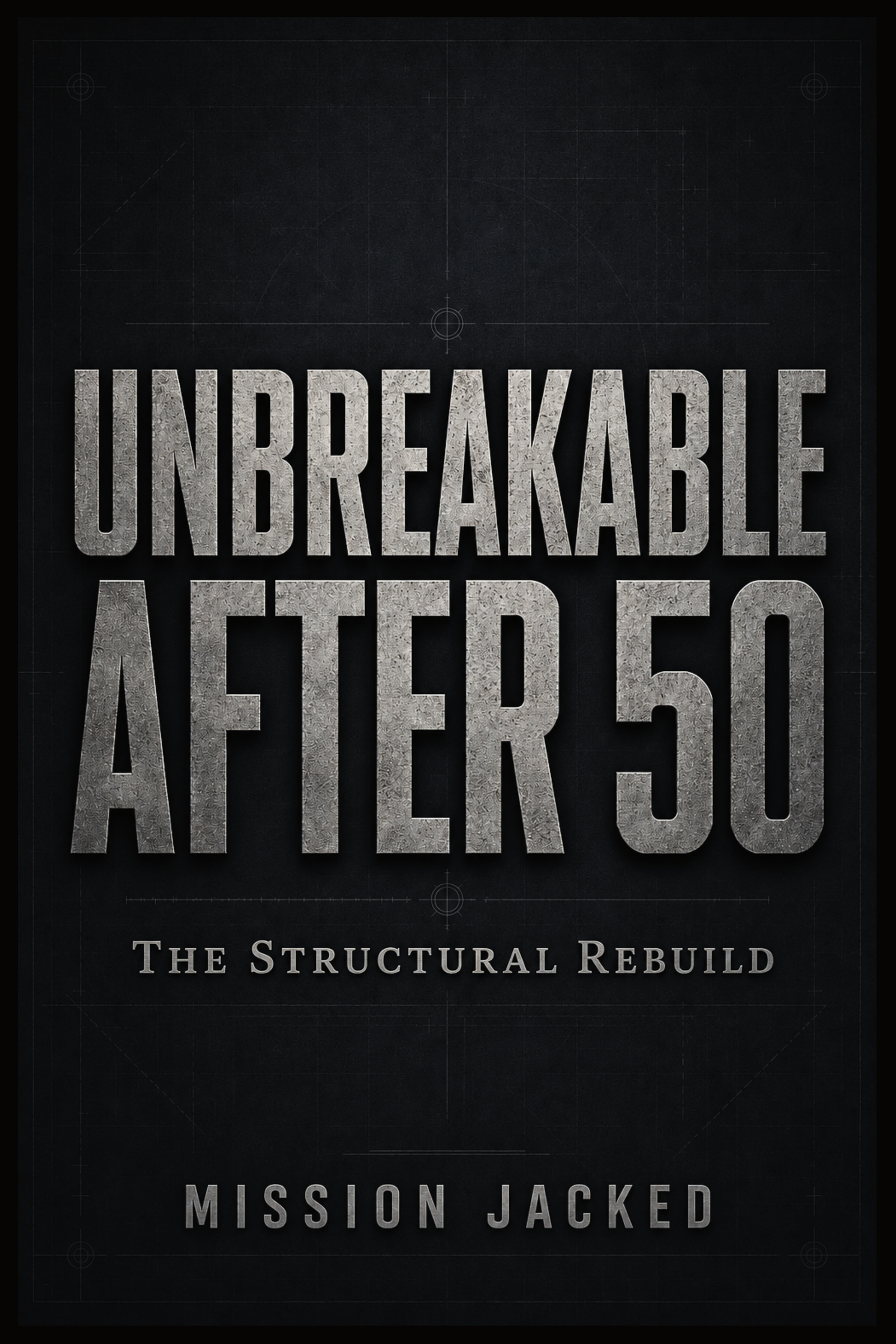
Unbreakable After 50: The Structural Rebuild treats the man as one connected system.
Across 74 chapters, it shows you how training, recovery, sleep, nutrition, energy, stress management and mental clarity work together to determine whether your strength remains available.
Not seven separate problems.
One structure.
Choose How You Want to Experience the Book
THE COMPLETE DIGITAL BUNDLE
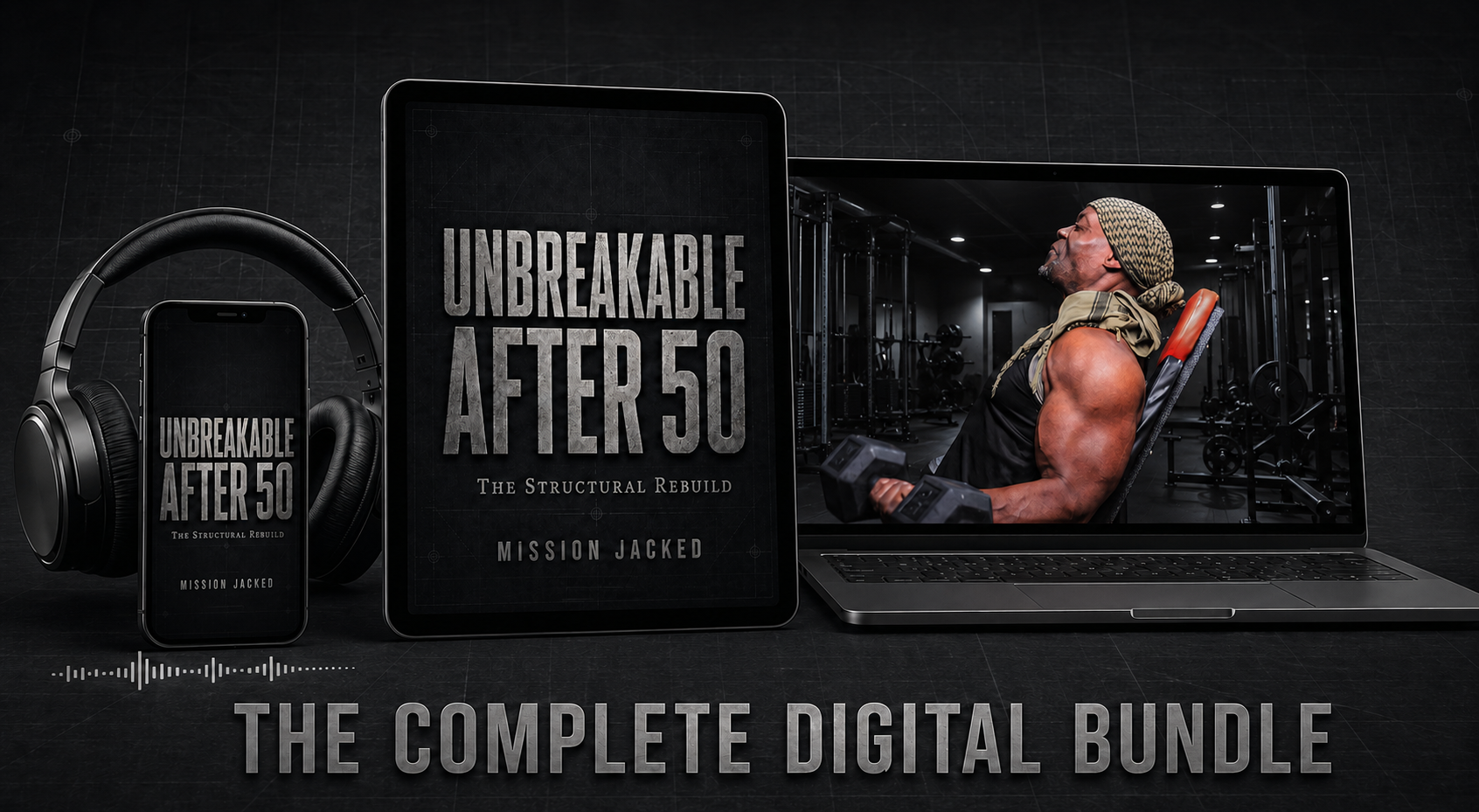
Get The Structural Rebuild eBook, the complete 74-chapter audiobook and an 18-minute workout-plan video.
Read it. Listen to it. See the plan explained. Build muscle. Keep something left for life.
CLICK NOW TO EXPLORE THE COMPLETE BUNDLE
EBOOK ON AMAZON - ASIN: B0HJB7DMXP
Click Your Country Below or Paste in the ASIN Number
THE 74-CHAPTER AUDIOBOOK (9-Hours)


Take the book into the hours you already have.
THE 74-CHAPTER AUDIOBOOK -Listen on your walk. During your commute. While getting on with the day.
Delivered through BookFunnel, so you can listen in its audiobook app without managing dozens of separate chapter files yourself. CLICK HERE!
THE COMPLETE eBOOK — EPUB + PDF
Work through the principles behind how you train, recover, eat and handle the demands of everyday life.
Explore slow high-intensity tension, muscular effort and recovery alongside sleep, walking, nutrition and stress management.
Use the EPUB for adjustable text on your phone or eReader. Keep the PDF for the fixed-page layout and easy reference. CLICK HERE!
Audiobook out on other platforms - Coming Soon
Paperback & Hard Cover - Coming Soon
Mission Jacked L.L.C
Address: 9407 NE Vancouver Mall Dr
STE 104 #1269
Vancouver, WA 98662 USA
Email: mission@missionjacked.com